Repeaters - VE8YK and VE8RAE
- Details
- Written by: Administrator
- Category: Understanding
- Hits: 8
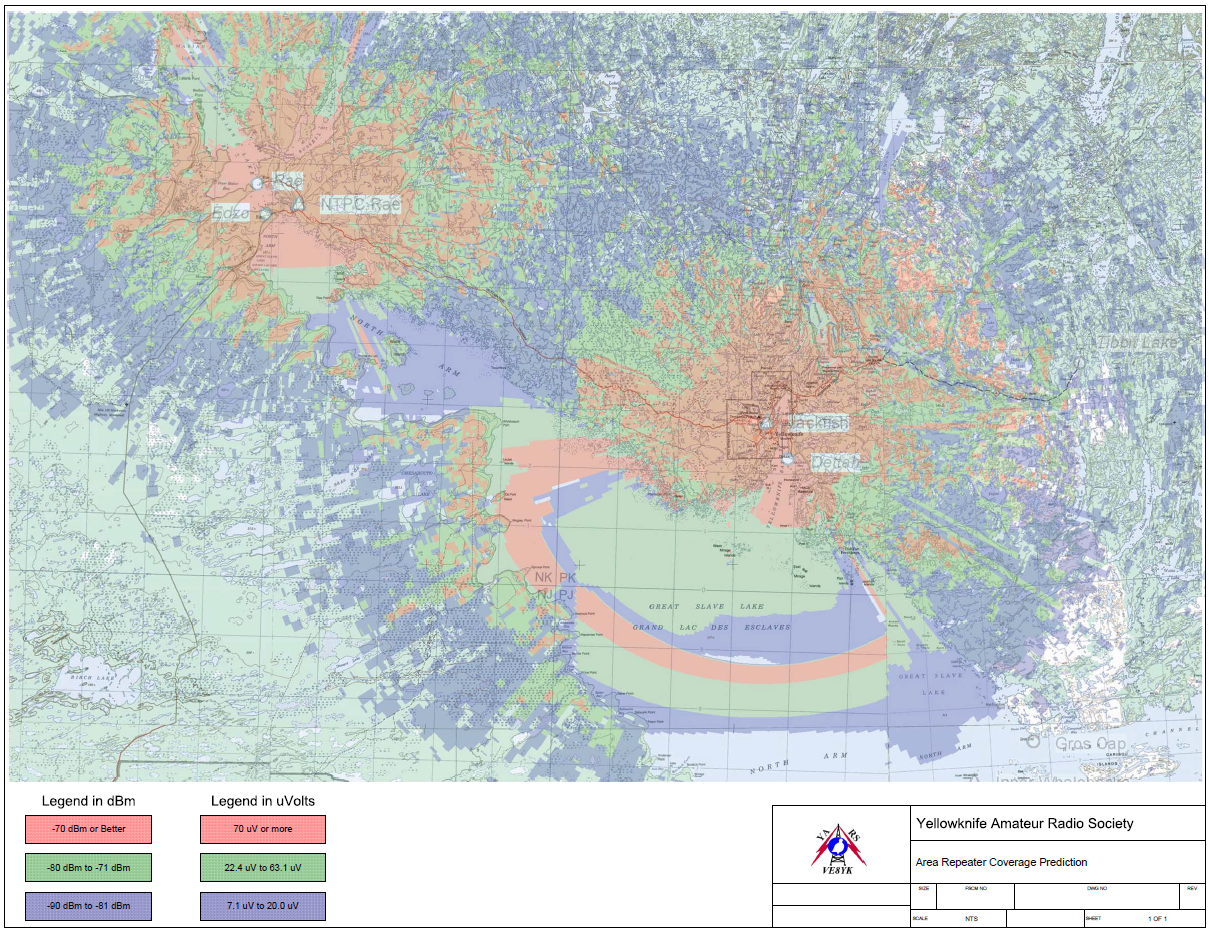
Area Repeater Coverage Map for the VE8YK and VE8RAE Repeater Network (2009)
The Yellowknife Amateur Radio Society maintains two repeaters on 2 metres that are linked. They are the Yellowknife repeater VE8YK located on a tower at Jack Fish Lake. The other is located on another tower located in Rae, about 1 hour away from Yellowknife (103 km), adjacent to Behchokǫ̀. The repeater is an Internet Relay Linking Project (IRLP) node.
Details for VE8YK:
- Downlink / Output: 146.940 MHz
- Uplink / Input: 146.340 MHz (Offset: -0.600)
- Uplink Tone (CTCSS): 100.0 Hz
- IRLP Node: 1642
Details for VE8RAE (No IRLP node but it is linked to VE8YK):
- Frequency: 145.1500 MHz (with a -0.600 MHz offset)
- Uplink Tone: 100.0 Hz
It should be noted that the Society is grateful to the entities who have allowed us to make use of space on their towers. The Society maintains these repeaters on its own and through the generosity of members and others who donate time and money to the Society. These repeaters perform a public service and have been relied upon during community events and emergencies. For many amateurs who do not have space to put up large HF antennas, this is a quick and easy way to communicate. The repeaters are also amenable to mobile stations. Please consider donating to the Society.
Membership
- Details
- Written by: Administrator
- Category: Society
- Hits: 153
Membership in the Yellowknife Amateur Radio Society consists of an annual membership fee. The fees are set out in the new draft Bylaws, which are generally the same as was decided at the 2018 AGM in accordance with the current Bylaws (Download YARS Constitution 1997).
Generally, there are four classes of membership granted payment of the applicable membership fee:
(a) full membership, granted to a licensed radio amateur with membership fee of $40;
(b) family membership, granted to a licensed radio amateur and their immediate family with a membership fee of $60 (all family members who hold an amateur radio licence are entitled to vote);
(c) associate membership, granted to an individual without a radio amateur licence with a membership fee of $20;
(d) corporate membership, granted to a corporation with a membership fee of $800.
Using GMRS and Meshtastic (LoRa) as Entry Point into Amateur Radio
- Details
- Written by: Administrator
- Category: Getting Licensed
- Hits: 246
During a Sunday coffee meeting, a discussion ensued about possible use of the GMRS/FRS radio system or something called “Meshtastic” as a supplementary radio system to get the public interested in radiocommunications as a first step in becoming interested in radios and advancing toward obtaining the basic amateur radio qualification to become an amateur radio operator. In this article, the author described both systems and considers their feasibility for the Yellowknife Amateur Radio Society.

Read more: Using GMRS and Meshtastic (LoRa) as Entry Point into Amateur Radio
RAC Basic Qualification Course - Remote (Fall 2026)
- Details
- Written by: Administrator
- Category: Getting Licensed
- Hits: 301
RAC Basic Qualification Course (see below for Advanced)
https://www.rac.ca/rac-basic-and-advanced-courses-fall-2026/
The Fall 2026 RAC Basic Qualification course will be starting on September 27. Registration is now underway.
Radio Amateurs of Canada is once again offering an online Amateur Radio course so that individuals from all across Canada can obtain their Amateur Radio Operator Certificate with Basic Qualification.
Course information:
The course will again be conducted with the assistance of the Annapolis Valley Amateur Radio Club (AVARC) of Nova Scotia.
This course prepares students for the Innovation, Science and Economic Development Canada (ISED) Basic Qualification Level Operator Certificate exam to operate on allocated Amateur Radio frequencies.
It is open to everyone across Canada and even abroad. Classes will be recorded, so occasional absences are not a problem.
Read more: RAC Basic Qualification Course - Remote (Fall 2026)
Highlights of 2026 Annual General Meeting
- Details
- Written by: Administrator
- Category: Society
- Hits: 206

The Yellowknife Amateur Radio Society AGM for 2026 was conducted on 2026-08-30.
Highlights:
- Five members in attendance (quorum established) - 09:00 AM
- AGM Minutes 2025 reviewed and approved
- A number of members paid their annual dues ($40 for individual; $60 for family; and $800 for corporate). Dues can be paid via electronic transactions to
This email address is being protected from spambots. You need JavaScript enabled to view it. . - Elections - by acclamation:
- President - Chris Cameron VE8WD
- Vice President - John Howe VE8JJ
- Secretary-Treasurer - Ian Rennie VE8IR
- Reports
- President - Update on Inner Whalebacks, VE8PAT and crank-up tower
- Secretary-Treasurer - financial statements; discussion over RAC affiliation and RAC insurance; proposed new bylaws; GNWT relations; CFARs;
- No new business
- Ajourned 10:04 AM
Amateur Radio/Scientific Software
- Details
- Written by: Administrator
- Category: Understanding
- Hits: 256
Amateur Radio Software
- WJSTX - Weak Signal communication by K1JT [Originally developed for radio astronomy and SETI, WSJT-X offers eleven different protocols or modes: FST4, FT4, FT8, JT4, JT9, JT65, Q65, MSK144, WSPR, FST4W, and Echo. Aimed at making QSOs including for meteorscatter and earth-moon-earth (i.e. moonbounce). Also Weak Signal Propagation Reporter (WSPR)]
- FLDIGI - Fldigi is a modem program for most of the digital modes used by radio amateurs today: CW, PSK, MFSK, RTTY, Hell, DominoEX, Olivia, and Throb are all supported. It can help calibrate a sound card to a time signal and do frequency measurement tests.
- N1MM+ - Ham Radio contest logging program
Scientific Software
- Spectran and more - Several programs but we have used Spectran for frequency analysis. There is a great usage of that program to listen to the beacon from a satellite's orbit decaying and burning up in the atmosphere. Used for NDS reception (the Society has done this too).
- linSmith - Smith Charting program. For analysis of discrete components or transmission lines.
Satellites Falling to Earth (Operation Morning Light 1978)
- Details
- Written by: Administrator
- Category: Civil Defence
- Hits: 248
Kosmos 954

Kosmos 954 (Wikipedia)
Satellites falling to the Earth may sound like an unlikely event of concern in the Northwest Territories, but it has happened and is therefore a foreseeable event. Kosmos 954 was one such satellite. Launched in September 1977 from the Baikonur Cosmodrome, Kosmos 954 was a reconnaissance satellite designed to monitor oceanic traffic including surface vessels and nuclear submarines using radar. It was powered by a liquid sodium-potassium thermionic converter driven by a nuclear reactor containing about 50 kg of highly enriched uranium (U235). By December its orbit became increasingly erratic. North American Aerospace Defence Command (NORAD) identified the satellite with Space Catalog Number 10361. Soviet Union officials warned their western counterparts that they had lost control of the satellite and that the system designed to safely eject the reactor core had failed. On 24 January the satellite re-entered the Earth's atmosphere on a northeastward track over western Canada. The debris field stretched for 600 km from Great Slave Lake to Baker Lake (now in Nunavut).
Read more: Satellites Falling to Earth (Operation Morning Light 1978)
Civil Defence
- Details
- Written by: Administrator
- Category: Civil Defence
- Hits: 213
{This article is partially original but also drawn verbatim from Wikipedia entries: Civil Defence; Civil defence by country - still being reviewed...}


Civil Defence logo on a Thunderbolt 1003 siren (Wikipedia)

Introduction
Civil defence is a concept aimed at the protection of citizens of a state who are non-combatants (hors de combat) from human-made or natural disasters. The concept has its origins in the First World War with the bombing by German Zeppelins and Gotha bombers of the population centres of England. In the 1920s the Air Raid Precautions Committee was established and it estimated that, based on the raids of World War 1, there could be as many as 17,500 casualties per week. With increasing political tensions in the 1930s and especially with the apparent air superiority of fascist Germany and Italy (and lessons from the Spanish Civil War - i.e. Guernica), the UK Civil Defence Service was established. Over 1.9M served with Civil Defence and 2,400 died from enemy action. The United States did something similar.
Bylaws Committee
- Details
- Written by: Administrator
- Category: Society
- Hits: 203
The Yellowknife Amateur Radio Society bylaws date from 1997 and may be found at: Download YARS Constitution 1997 . They are out of date and do not reflect current Society procedures or aspects of the current Societies Act under which the Society is incorporated. The GNWT Societies Registry has some public resources about amending bylaws. This will cost the Society $20. While the file name says Constitution, the title of the document is Yellowknife Amateur Radio Society Bylaws. Therefore this is a bylaws project.
Weekly 2 m Net
- Details
- Written by: Administrator
- Category: Ensign
- Hits: 204
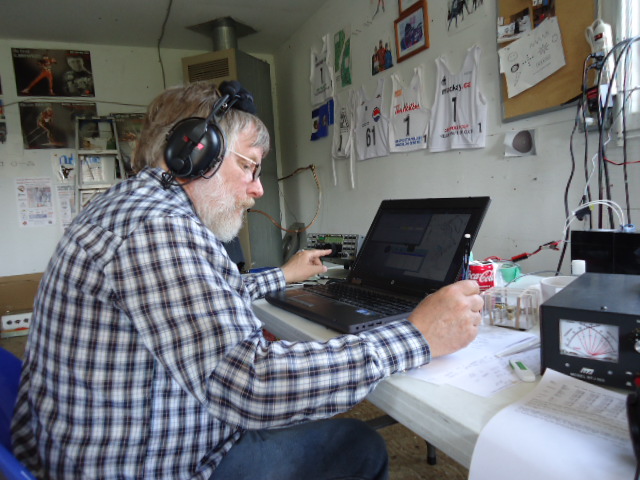
VE8RT in Action (YARS Photo)
There is a weekly VHF radio net every Sunday at 9:00 PM local time on the local repeater system here in Yellowknife. The repeater is also an IRLP node 1642 and check-ins are welcome to call in.
- Sunday, 9:00 PM Local Time
- VE8YK/R (146.940 MHz with -600 kHz offset with a 100 Hz sub-audible tone) based in Yellowknife (IRLP was verified as functional as of 2023-08-02 by VE8IR and M0XWS and VE8RT); and
- VE8RAE/R (145.150 MHz with -600 kHz offset) based in Behchokǫ̀ (formerly Rae).
Page 1 of 2